


Q: Can manipulation damage your spine?
A: Answer by Dr. Robbie Goodrum, PhD, UK registered physiotherapist and osteopath with 33 years of experience. I always use our unique APBC mobilization and APBC soft approaches on all my patients first, then if symptoms persist, I may use more dynamic manipulative techniques, especially on disc problems, using specific short-lever grade 5 manipulation. We find our treatments only use HVT in some cases around 5% of the time.
Click Here Video of Gentle APBC Short-Lever Techniques

Q: What’s the function of the spinal ligaments ?
A: The ligament’s job is to bind bone to bone and stabilize the structure. The more manipulation or grade 5 HVT we use, thus passing the paraphysiological barrier, the more instability will be inadvertently caused, this is another reason to focus on soft tissue techniques and APBC mobilization to restore normal function. Interestingly, what chiropractors fail to understand is subluxation or joint misalignment or joint somatic dysfunction is caused by ligament instability from micro or macro trauma.
Q: What happens with minor spinal ligament instability?
A: The body adapts by initiating the postural muscles (Multifidus, Rotatores, Interspinales, Intertransversarii, Quadratus lumborum, Psoas major, Iliacus, Erector spinea (iliocostalis, longissimus, spinalis), Latissimus dorsi, Transversus abdominis, Internal oblique, External oblique) to tighten, to control and stabilize the segmental spinal motor unit, where ligaments are damaged. The hypo-mobility, or stiffness we feel in a spinal segment is often hyper-mobility with compensatory muscle spasm. It tricks us. Instability of ligaments is compensated by our postural muscles to slightly contract to stabilise us – this constant contraction causes fatigue and muscle spasm.

Q: How does manipulation help temporarily?
A. In the manipulation process, we are changing joint position, gapping joints, deactivating mechanoreceptors: Ruffini endings, Pacinian corpuscles, Golgi tendon organs, and free nerve endings. Once the mechanoreceptors type 1-4 turn off via the manipulation, the postural muscles turn off from being compensatory stabilizers. (they stop contracting and rest. ) Remember, once ligaments in the spine or SIJ are stretched, they never get repaired by collagen to the original. Maybe 80% repaired but not 100%, so this leaves instability and the cycle of muscles taking over as primary stabilizers continues. After some time, a few days or a week, the subluxations or misalignments come back, then the instability of the spinal ligaments and capsular structures complain of being damaged, then the postural muscles turn back on again to be primary stabilizers, and then grade 5 HVT is needed again to break the pain cycle repeats again. Every time an operator uses a HVT manipulation, you do slightly damage the periarticular capsule. SO IS HVT INDICATED SO OFTEN – I say no, definitely not for chronic pain.
Q: What are the indications of HVT manipulation with APBC Technique ?
A. APBC Technique only uses HVT for:
1. Unresolved APBC Discogenic pain. Dynamic Techniques and rehab will be needed in the more difficult cases.
2. Disc problems with radicular symptoms. HVT will be needed in cases like this around 10% of the time (90% we fix discs with gentle specific APBC Technique) obeying the concave-convex rule of disc manipulation + traction.
3. 90% of the time, we fix complicated SIJ issues with our safe gentle APBC technique, sometimes the SIJ or spine has restricted ‘capsular adhesions’ maintaining subluxation with pain. HVT can break down fibrous spinal capsular adhesions restoring joint motion.
Q: What have I experienced from seeing 20 chiropractors myself in USA, UK, Australia, and Europe over 20 years?
A. I’ve experienced Chiropractors using excessive manipulation for weeks and months with myself – which destabilized my SIJ and spine with repeated heavy manipulation. And it’s not just my story; this is usual of chiropractors to give weekly monthly adjustments for years to chronic pain patients. Really, colleagues, the Ligament’s Job is to stabilize the spine and NOT be repeatedly stretched.
Q: How long did you study?
A. After myself studying massage, Sport-massage, Sport-Therapy, Physiotherapy, Osteopathy, and Chiropractic over 13 years full-time, this education gave me the right tools to select the right technique for the right pathology.
Click Here Dr. Robbie’s Resume

This is the key to my APBC Technique. All our professions, physiotherapy, osteopathy, chiropractic, can be very good if applied right; all have strong and weak points too. Just sometimes, a surgeon is needed to fix the gross mechanical problem.
Q: What does APBC teach you?
A. APBC technique teaches you the right technique for the right pathology.
Q. What is APBC Technique?
A. APBC is Dr. Robbie Goodrum’s unique specific manipulative technique developed over 33 years. APBC is modified from the best techniques from osteopathy, chiropractic, and physiotherapy, but nowadays, after 33 years, all the hands-on techniques are Dr. Robbie’s own safe APBC soft tissue techniques, mobilizations, and manipulative techniques.
Dr. Robbie also adds a holistic naturopathic approach to tissue healing and fast recovery. APBC is a specific low-force mobilization 90% and a Grade 5/HVT manipulative technique HVT 10% with the ‘classical click’ that we hear, or low amplitude HVT. We assess ligament stability of the periarticular joint structures and carefully plan the appropriate technique. The primary rule in APBC technique is not to use techniques that hurt the practitioner and not to use techniques that over-stretch ligaments.
Q. Can manipulation cause instability?
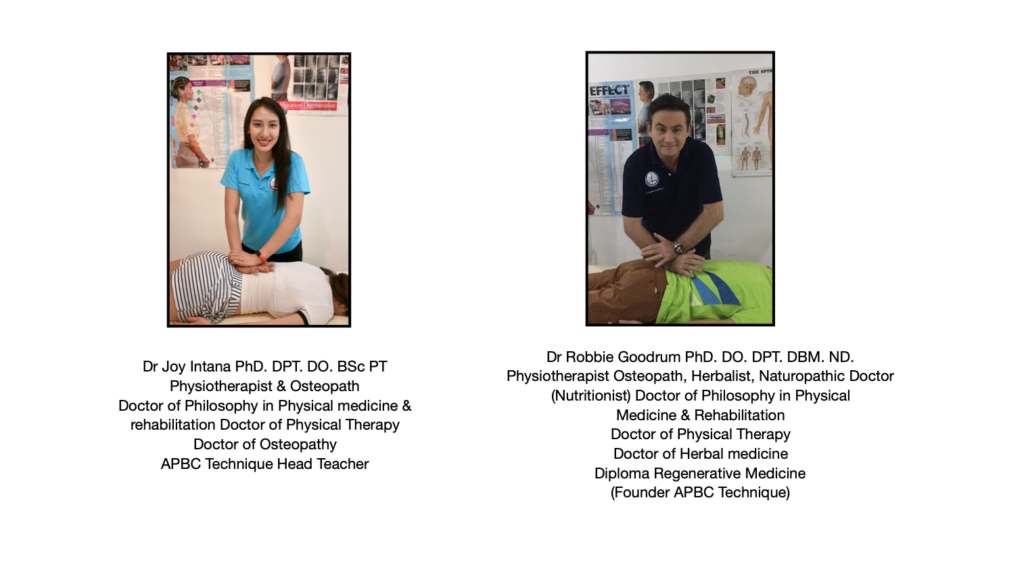
A. Let me tell you a story about pain, suffering, and chiropractic, and a beautiful young woman with no neck pain. Dr. Joy today, well, at the time, she was just Joy, received the chiropractic adjustment on my seminar in 2013 from an American Chiropractor who I employed; he prolapsed her disc in the cervical at C7 at 25 years old with no injury or neck pain in her life. (She was just being a model) The injury resulted in 2 years of treatment until I took her for Prolotherapy for stabilization injections for severe spinal joint instability caused by 1 heavy powerful manipulation.
Another story – let’s dig deeper
Myself, Dr. Robbie Goodrum, after using HVT and side posture for 15 years, developed shoulder instability and pain needing surgery at 40 and then again 45 years old. My shoulder had no injury, just micro-trauma from giving chiropractic side posture for 15 years to 30-40 patients a day = repetitive micro-trauma. 5 of my chiropractic and osteopathic colleagues all had surgery before they were 55 on either their wrist, elbow, shoulder, neck, or back after 15-20 years of use of HVT. Most chiropractors can’t do HVT past 60 years old after 35 years in practice because of damage to their own bodies.
APBC technique is now 10 years old since 2016 – prior to this I was teaching Modified Chiropractic & Osteopathy from 1993 to 2015.
Q. What is your future?
A. APBC technique will teach you proper ergonomics and patient control to not hurt yourself, so you can practice until you’re 85 and beyond if you so wish.
Click Here Testimonials APBC Course